Variable fonts
Use a variable font when one file should provide several weights or widths: it stores a default face plus deltas along designer-defined axes, and any position on those axes is a valid instance. The package lists the axes, reads measurements and outlines at a chosen position, and keeps the axes intact when writing or subsetting: a position is read through a view, and files are written from the source with all its axes.
List the available axes
Place a variable TrueType font at fonts/Variable.ttf, then run this script
beside vendor:
<?php

require __DIR__.'/vendor/autoload.php';

use Alto\Font\Font;

$font = Font::fromFile(__DIR__.'/fonts/Variable.ttf');
$variations = $font->variations();

if (null === $variations) {
    echo "This is a static font.\n";
} else {
    foreach ($variations->axes as $axis) {
        printf(
            "%s: %g to %g, default %g\n",
            $axis->tag,
            $axis->minimum,
            $axis->maximum,
            $axis->default,
        );
    }
}
For a weight axis, a line might be wght: 100 to 900, default 400. The actual
ranges depend on the file. Axes also expose their optional name and hidden
flag; named presets are available through $variations->instances.
What the file contains
A static font stores one face per file. A variable font adds deltas that move
outline points and adjust metrics: fvar declares the axes and the named
instances such as Bold or Light, avar remaps axis values, gvar holds the
outline deltas for glyf fonts, HVAR, MVAR, and VVAR hold the metric
deltas, and STAT describes the design space. Without them, the remaining
tables form a complete static font: the default instance. The package reads
TrueType-flavored variable fonts: glyf with gvar, avar, and HVAR.
Compare a glyph at another weight
Continue the script with a font that has a wght axis and contains A:
<?php

if (null === $variations || !$variations->hasAxis('wght')) {
    throw new RuntimeException('Choose a variable font with a weight axis.');
}

$bold = $font->withVariations(['wght' => 700]);

printf("Default A advance: %g\n", $font->glyphMetrics('A')->advanceWidth);
printf("Selected A advance: %g\n", $bold->glyphMetrics('A')->advanceWidth);
Both values are in font design units. They may be equal if that glyph's advance
does not vary. Use $bold->glyphOutline($bold->glyphMetrics('A')->glyphId) to read
its selected outline as well. The original $font remains unchanged.
Values outside an axis range are clamped. Unknown axes and selections on
static fonts raise InvalidFontException. Query the available axes before
assuming that a font has width (wdth) or any other axis.
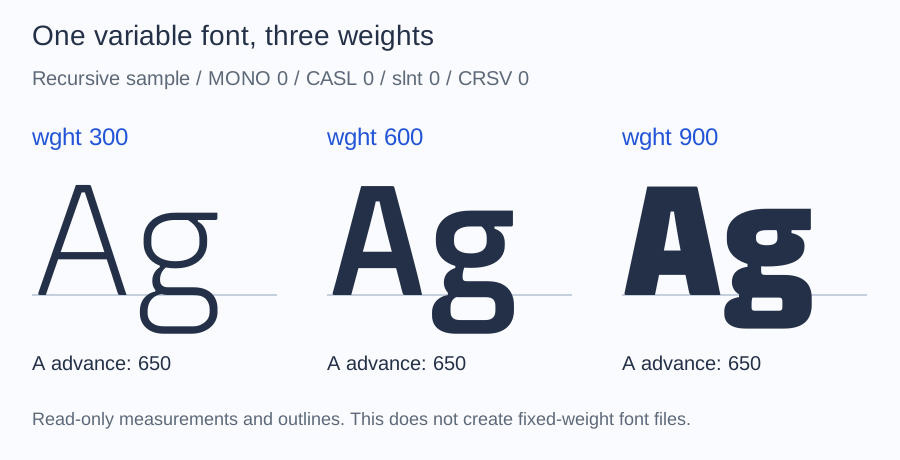
This uses the bundled Recursive-derived sample, with the other axes fixed as
shown. The outline changes while A keeps the same 650-unit advance. Each
column comes from an ALTO read-only view; no static font was exported. Glyphs
are placed by their advances without text shaping or kerning.
The illustration uses the bundled variable-font fixture.
Return to the source for conversion or subsetting
$bold->withoutVariations() returns the original variable source with all its
axes. It does not freeze weight 700. A weighted finder query
can also return a selected view, with the same writing restrictions.
Select coordinates
variations(): ?FontVariationsreturns the axes (tag, minimum, default, maximum, flags, optional name) and the named instances, ornullfor a static face.withVariations(array|VariationCoordinates $coordinates): Fontreturns a new view at the requested position. Array keys are axis tags; values are integers or floats. Unspecified axes use their defaults, out-of-range values are clamped, and an unknown axis or a static font raisesInvalidFontException.variationCoordinates(): ?VariationCoordinatesreturns the resolved coordinates of a view, ornullfor the source.withoutVariations(): Fontreturns the source with all its axes; on the source itself it returns the same object.
A VariationCoordinates object can also be built with defaults($variations)
and with(). A view affects glyph measurements and outlines; it is not a
static font, and writing or subsetting it raises UnsupportedFontException.
Text shaping and rendering at those coordinates belong to the application.
Subset a variable font
A subset keeps every axis of its source: compact mode remaps the per-glyph
gvar data and the HVAR and VVAR mappings together with the glyphs, and
rebuilds the variation stores without unrelated bytes. To subset a view
created with withVariations(), return to the source with
withoutVariations() first. See Policies.