Glyph counts
A font stores its glyphs in numbered slots, from 0 to one less than the count
declared in its maxp table. face()->glyphCount reports that count. Slot 0
holds .notdef, the shape displayed for a character the font does not map,
and every subset keeps it.
The count is not the number of characters the font covers. A compound glyph
references other glyphs as components, a ligature or an alternate form is
reached through a substitution rule rather than through the character map, and
one glyph can serve several characters. To check one character, use
glyphIdForCodepoint(); see Glyphs.
Counts reported after subsetting
SubsetResult reports three counts:
mappedCodepointCountis the number of requested codepoints found in the character map.retainedGlyphCountis the number of glyphs kept: the mapped glyphs, slot 0, compound components, and the glyphs reachable through preserved substitutions.originalGlyphCountis the number of slots in the source.
The slot count of the new font depends on the numbering policy. Preserve
keeps every slot and empties the unused ones, so face()->glyphCount stays
equal to the source. Compact renumbers the retained glyphs, so the two
counts match. See Policies.
Measured on the Inter sample
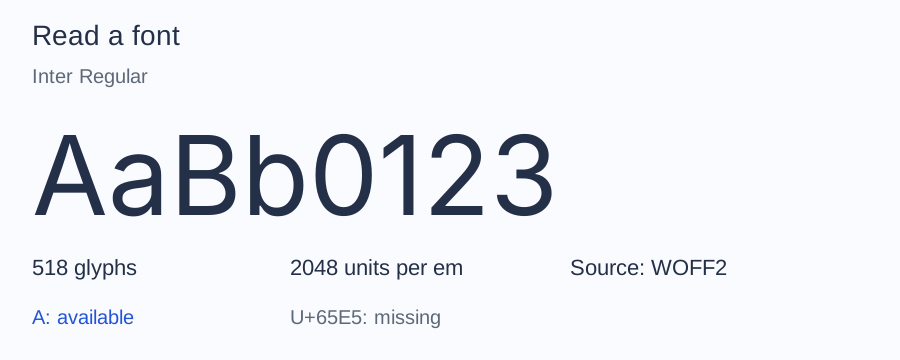
The bundled Inter Latin sample has 518 slots:
The text ALTO Font 0123456789 contains 19 distinct characters, all mapped:
| Policies | Retained glyphs | Slots in the output | WOFF size |
|---|---|---|---|
| Defaults | 104 | 518 | 19,784 bytes |
| Compact numbering | 104 | 104 | 8,308 bytes |
| Layout dropped | 20 | 518 | 5,608 bytes |
| Compact numbering, layout dropped | 20 | 20 | 2,752 bytes |
With layout preserved, the substitution rules of the font pull in 84 glyphs
beyond the 19 characters and .notdef. Dropping layout keeps exactly those 20.
The hinting policy changes the size, not the counts.